Showing posts with label algorithm. Show all posts

Tuesday, December 10, 2019

Schneider Electric brings out its initial integrated rack with immersed, liquid-cooled IT for data centers

Schneider Electric, alongwith Avnet and Iceotope, announced on Monday  creation its commercially-available integrated rack with chassis-based, immersive liquid cooling. Optimized for compute-intensive applications, the solution combines a high-powered GPU server with Iceotope's liquid cooling technology to increase energy efficiency. 


Avnet integrates the liquid-cooled server with Schneider Electric's NetShelter liquid-cooled enclosure system for simple deployment into data centers or edge computing environments. The system is EcoStruxure Ready since the solution is available with next generation data center management software, EcoStruxure IT Expert, and digital service EcoStruxure Asset Advisor. 


This liquid-cooled solution is ideal for applications such as big data analytics, artificial intelligence, and machine-learning algorithm training development, where high compute demands more energy use. In a recent report published by Gartner, liquid cooling was identified as a technology to watch. 


The parallel-processing power of Graphical Processing Units, known as GPUs, makes them efficient processor for a growing number of applications including AI, big data analytics, data mining, and more. The chips are increasingly power dense with thermal design power ratings reaching 400 watts or more. 


This makes traditional data center air-cooled architectures impractical, or costly and less efficient than liquid-cooled approaches where the server is partially submerged in a dielectric fluid. 


Liquid cooling delivers efficiency removing the need for air conditioning, while offering the same processing power with less energy. It is also silent as it does not include industrial drone from fans and pumps; delivers resilience as all components are in a sealed module that resists dust and smoke; and comes in a compact size to offer smaller and more flexible footprint.


Analyst Henrique Cecci advised data center operators "maximize cooling energy efficiencies by employing modern liquid cooling solutions1." Liquid cooling offers greater efficiency, lower operating costs, smaller footprint, increased reliability, and nearly silent operation despite the high-power density of the GPUs. Avnet, Iceotope, and Schneider Electric plan to expand the offering as demand grows by welcoming other server OEMs into the partnership. 


"Schneider Electric is committed to making data centers more sustainable and liquid cooling is a very compelling approach," said Kevin Brown, CTO and SVP of Innovation, Secure Power, Schneider Electric, who is presenting on liquid cooling at the Gartner conference. "This latest development marks a significant step toward industrializing chassis-based immersion solutions which offer the efficiency and effectiveness of tanks based solutions while providing the compatibility and serviceability of more traditional, 'direct-to-chip' liquid-cooling designs.  Given the growth of compute-intensive applications, we believe this approach is very promising."

Thursday, October 31, 2019

Intel Xeon E-2200 processors deliver additional layer of hardware-based security and manageability

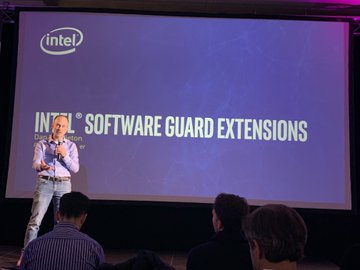
Intel announced Thursday general availability of Intel Xeon E-2200 processors taking another step forward in data center security. Popular for small-medium business deployments, Intel Xeon E processors are also driving enhanced security usages with the additional layer of hardware-based security and manageability made possible by Intel Software Guard Extensions (Intel SGX). 

A key priority at Intel is enabling features that will help protect sensitive customer data – and Intel SGX does just that.

The new 8-core Intel Xeon E-2200 processors enable servers to operate at frequencies reaching up to 5.0 GHz (with Intel Turbo Boost Technology 2.0) and feature expanded capacity for hardware-enhanced security with double the Intel SGX Enclave Page Cache (EPC), now 256MB, and side-channel mitigations in hardware. 


Intel invests heavily in security, and the larger enclave sizes enable larger code and datasets to be encrypted in the SGX enclave, expanding the usages of Intel SGX, and paving the way for additional data center security innovations like AI architectures including federated learning.

Federated Learning is a machine learning paradigm where many compute systems are “federated” together to analyze large and/or diverse datasets. However, current approaches to AI can require complex webs of trust, where the data or the algorithm could be exposed to an untrusted party. Trusted Execution Environments (TEEs) such as Intel SGX provide a means for processing the data within protected enclaves.


This facilitates the advantages of cross-industry machine learning while still helping to maintain the privacy of individual data and the confidentiality of proprietary algorithms. Rival banks could build joint anti-money laundering models. Hospitals could use remote, 3rd party analytics on patient data. Retailers could monetize their purchase data while keeping a focus on user privacy.

Federated Learning is an example of new security innovations that Intel SGX can enable. Intel’s ecosystem partners bring new ideas to the table constantly with customer data protection as a top priority. Microsoft has been at the forefront of confidential computing in the cloud with Azure. 

“The new Intel Xeon E-2200 processor unlocks additional enclave space which opens up new scenarios and improves performance. Microsoft plans to roll-out Xeon E-2200 based confidential computing clusters in UK South and Canada within the first quarter of 2020,” said Scott Woodgate, Azure Security, Microsoft.


Confidential Computing is an emerging industry initiative focused on securing data in-use, especially in multi-tenant cloud environments where the goal is to keep sensitive data isolated from all other privileged portions of the system stack. 

Intel SGX plays a large role in making this capability a reality, both at our own company and throughout the industry. As computing moves to span multiple environments from on-prem to public cloud to edge, it is no wonder companies are looking for protection controls that help to safeguard sensitive IP and workload data wherever their data resides.

Intel is also making investments in the ecosystem like joining the Confidential Computing Consortium and contributing the Intel SGX Software Development Kit to support a broad industry push to address the latest frontier for data confidentiality in the cloud.

Masimo secures FDA clearance for neonatal RD SET Pulse Oximetry sensors with improved accuracy specifications

Masimo announced that RD SET sensors with Masimo Measure-through Motion and Low Perfusion SET pulse oximetry have received FDA clearance ...