Showing posts with label file storage. Show all posts

Friday, December 20, 2019

Commvault data protection software now fully tested and validated to support AWS Outposts

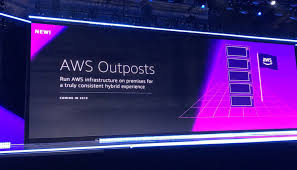
Commvault announced on Thursday that Commvault software has been tested and validated to support AWS Outposts, which is a new, fully-managed service that extends Amazon Web Services (AWS) infrastructure, services, APIs and tools to virtually any data center, co-location space, or on-premises facility for a truly consistent hybrid cloud experience.

Many customers need to keep certain workloads on-premises while managing other workloads in the cloud. Commvault has robust and expansive support for the ever-growing number of diverse workloads rapidly migrating to AWS from other platforms and delivers the same look, feel and performance for data protection and management on-premises as it does in the cloud. 


As a complement to AWS Outposts, Commvault’s software provides a true single solution, not just a single interface, which creates cost efficiencies, provides simplicity and reduces risk.

Commvault is an Advanced Technology Partner in the AWS Partner Network (APN) and holds AWS Storage Competency status. Working with the AWS engineering team allows Commvault to offer integrated cloud storage solutions and support, giving customers the ability to migrate, backup and store data in the cloud. The depth and breadth of Commvault’s software with the wide array of storage services available from AWS allows customers to rest assured that their data is secure and available in the cloud. 


“Our tested and validated support for AWS Outposts allows our customers to leverage Commvault’s powerful cloud data protection and management capabilities on AWS,” said Karen Falcone, Vice President of Worldwide Cloud GTM, Commvault. “With the growth of cloud services and so many Commvault customers moving into AWS, we are helping organizations achieve the same level of data protection in the cloud as they did on-premises without the complexity and costs of installing and managing infrastructure.”

In October, Commvault announced product and experience enhancements to Commvault Activate, its data insights and governance solution that gives users greater visibility into their data, identifies opportunities for storage efficiencies and manages risk. Enhancements include the addition of file access controls for file storage optimization and new redaction functions with sensitive data governance. 

Friday, November 22, 2019

Veritas and NetApp deliver data protection of unstructured data for customers

Veritas Technologies announced an expansion of its partnership with NetApp that will help the largest enterprises protect their data more quickly and at scale on NetApp network-attached storage (NAS) devices.  


Veritas NetBackup leveraged NetApp SnapDiff APIs in 2012 to accelerate backup of primary NAS data to on-premises and cloud targets. By integrating with NetApp SnapDiff on secondary NAS, customers can meet stringent recovery time objectives (RTOs) on their premises and speed up data transfer to the cloud for long-term retention. 


This integration further strengthens the value to joint customers, adding faster unstructured data protection to capabilities such as business resiliency for applications connected to NetApp storage, and deep file analytics for NetApp NAS data.


The continued partnership between Veritas and NetApp offers customers numerous benefits, including business resiliency through integration of tier 1 applications and storage into high-availability and disaster recovery solutions; ability to protect file data on the premises and in the cloud across physical and virtual deployments; insights and deep file analytics through cataloging to better understand what data sits where, and how many copies are maintained; reduced TCO by tiering backup data to the cloud for long-term retention; and the ability to continuously meet stringent SLAs even as unstructured data increases.

Monday, November 18, 2019

New Trend Micro Cloud One platform automates and simplifies cloud security to deliver flexibility in the cloud

Trend Micro launched on Monday its Trend Micro Cloud One, a security services platform for organizations building applications in the cloud. Cloud One allows developers to rapidly build applications using the cloud services they want, while managing their organization’s risk.


Cloud One delivers a range of security capabilities in a single platform. Designed to help organizations meet their most strategic cloud priorities, it allows customers to migrate existing applications to the cloud, deliver new cloud-native applications and achieve cloud operational excellence.


The platform has the flexibility to solve immediate customer challenges and the innovation to rapidly evolve with cloud services. 


At its heart, Cloud One includes workload security service that is already in use by thousands of organizations. It is complemented by enhanced container security and brand-new offerings for application security, network security, file storage security and cloud security posture management to ensure cloud infrastructure is optimally configured.


The Cloud One platform will be available in the first quarter of next year with three services fully integrated: workload security, network security and application security. The other components will be available as stand-alone solutions in the first quarter next year, and integrated into Cloud One by the end of the year.

Monday, November 4, 2019

Qumulo boosts HPE Apollo Gen10 lineup, making unified hybrid cloud unstructured data storage and real-time insights possible

Qumulo announced Monday global availability of a new line of fully integrated file storage solutions on the highly performant Hewlett Packard Enterprise (HPE) Apollo 4200 Gen10 servers. The new solution provides enterprise organizations scalable, software-defined file storage with deep data visibility into unstructured data workloads that scale-across on-premise, hybrid and cloud environments.

HPE Apollo Gen10 addresses storage-centric workloads while adapting to future requirements with a superior hardware system architecture that is data-secure by design throughout the product lifecycle. 


HPE’s new technology, called silicon root of trust, allows enterprise organizations to be confident that nowhere in the supply chain were modifications made to hardware platforms. Coupled with FIPS 140-2 encryption-at-rest, the new Gen10-based platforms deliver innovation for secure, enterprise file storage.


The joint solution provides ultra-dense rack-scale file storage, low total cost of ownership (TCO) in a 2U chassis, and configurations optimized for performance, mixed workloads, and active archive. Geographically dispersed environments can leverage continuous replication to move data between data centers and the public cloud.

The file storage market is growing rapidly to process, analyze and store massive unstructured data sets. Analyst firm IDC reports that the scale-out file storage market will become an US$11 billion market by 2022, up nearly two times from previous forecasts.


“Global enterprises are increasingly looking to scalable file storage to address their massive unstructured data processing, analytics and retention demands,” said Amita Potnis, Research Director, Infrastructure Systems, Platforms and Technologies Group at IDC.

“By delivering our scale-across file storage technology as software, Qumulo provides customers an unprecedented level of choice, freedom and flexibility. Our software model enables customers to benefit from the world’s most capable and simple-to-manage file system, while at the same time, taking advantage of the significant advancements from HPE in security and predictive analytics to prevent infrastructure problems before they happen,” said Bill Richter, CEO of Qumulo. “Qumulo’s file storage, delivered on the Apollo Gen 10 platform, offers companies the best of both worlds. I’m delighted that the partnership with HPE delivers on our joint promise of innovation and customer success.”


“The powerful combination of HPE Apollo 4200 Gen10 servers, together with Qumulo’s hybrid cloud file storage, effectively addresses the growing unstructured data needs that enterprises are facing,” said Patrick Osborne, vice president and general manager for big data, analytics and scale-out data platforms at Hewlett Packard Enterprise.. By sharing our vision of the intelligent data platform, we provide the ability to scale and manage billions of files with instant control at lower costs and high performance on-prem, in the cloud, or spanning both, now and into the future.”

Thursday, October 31, 2019

Cray debuts ClusterStor E1000 storage to power data-driven workloads including AI, analytics, simulation and modeling

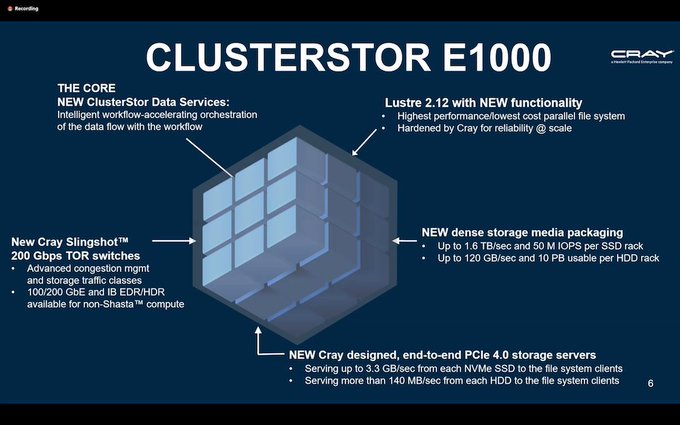
Cray, a Hewlett Packard Enterprise company unveiled on Wednesday its Cray ClusterStor E1000 system, a new parallel storage platform for the exascale era. ClusterStor E1000 addresses the explosive growth of data from converged workloads and the need to access that data at improved speed, by offering an optimal balance of storage performance, efficiency and scalability, effectively eliminating job pipeline congestion caused by I/O bottlenecks. 

Cray ClusterStor E1000 systems will be available starting in the first quarter of next year. 


The next-generation global file storage system has already been selected by the US Department of Energy (DOE) for use at the Argonne Leadership Computing Facility, Oak Ridge National Laboratory and Lawrence Livermore National Laboratory, where the first three US exascale supercomputers will be housed (respectively Aurora, Frontier and El Capitan).


With the introduction of the ClusterStor E1000 storage system, Cray has completed the re-architecture of its end-to-end infrastructure portfolio, which encompasses Cray Shasta supercomputers, Cray Slingshot interconnect, and the Cray software platform. With Cray’s next-generation end-to-end supercomputing architecture, available for any datacenter environment, customers around the world can unleash the full potential of their data.


Recognizing data access challenges presented by the exascale era, Cray’s ClusterStor E1000 enables organizations to achieve their research missions and business objectives faster. ClusterStor E1000 systems can deliver up to 1.6 terabytes per second and up to 50 million I/O operations per second per rack – more than double compared to other parallel storage systems in the market today.

The new system also deliver purpose-engineered end-to-end PCIe 4.0 storage controllers serve the maximum performance of the underlying storage media to the compute nodes and new intelligent Cray software, ClusterStor Data Services, allows customers to align the data flow with their specific workflow, meaning they can place the application data at the right time on the right storage media (SSD pool or HDD pool) in the file system.
An entry-level system starts at 30 gigabytes per second and at less than 60 terabytes usable capacity. Customers can start at the size dictated by their current needs and scale as those needs grow, with maximum architectural headroom for future growth. 


The ClusterStor E1000 storage system can connect to any HPC compute system that supports high speed networks like 200 Gbps Cray Slingshot, Infiniband EDR/HDR and 100/200 Gbps Ethernet.

Masimo secures FDA clearance for neonatal RD SET Pulse Oximetry sensors with improved accuracy specifications

Masimo announced that RD SET sensors with Masimo Measure-through Motion and Low Perfusion SET pulse oximetry have received FDA clearance ...