Showing posts with label dataset. Show all posts

Thursday, December 12, 2019

Amazon SageMaker Ground Truth enables auto-segmenting of objects when performing semantic segmentation labeling

Amazon Web Services announced Wednesday that its Amazon SageMaker Ground Truth helps build highly accurate training datasets for machine learning (ML) quickly. Ground Truth offers easy access to third-party and own human labelers, and provides them with built-in workflows and interfaces for common labeling tasks. 

Additionally, Ground Truth can lower labeling costs by up to 70 percent using automatic labeling, which works by training Ground Truth from data humans have labeled so that the service learns to label data independently. 

Amazon SageMaker Ground Truth helps users build highly accurate training datasets for machine learning quickly. SageMaker Ground Truth offers easy access to public and private human labelers and provides them with built-in workflows and interfaces for common labeling tasks. Additionally, SageMaker Ground Truth can lower labeling costs by up to 70 percent using automatic labeling, which works by training Ground Truth from data labeled by humans so that the service learns to label data independently.


Successful machine learning models are built on the shoulders of large volumes of high-quality training data. But, the process to create the training data necessary to build these models is often expensive, complicated, and time-consuming. The majority of models created today require a human to manually label data in a way that allows the model to learn how to make correct decisions. 

For example, building a computer vision system that is reliable enough to identify objects - such as traffic lights, stop signs, and pedestrians - requires thousands of hours of video recordings that consist of hundreds of millions of video frames. Each one of these frames needs all of the important elements like the road, other cars, and signage to be labeled by a human before any work can begin on the model that the user wants to develop.

Amazon SageMaker Ground Truth reduces the time and effort required to create datasets for training to reduce costs. These savings are achieved by using machine learning to automatically label data. The model is able to get progressively better over time by continuously learning from labels created by human labelers.

Where the labeling model has high confidence in its results based on what it has learned so far, it will automatically apply labels to the raw data. Where the labeling model has lower confidence in its results, it will pass the data to humans to do the labeling. 

The human-generated labels are provided back to the labeling model for it to learn from and improve. Over time, SageMaker Ground Truth can label more and more data automatically and substantially speed up the creation of training datasets. 


Semantic segmentation is a computer vision ML technique that involves assigning class labels to individual pixels in an image. For example, in video frames captured by a moving vehicle, class labels can include vehicles, pedestrians, roads, traffic signals, buildings, or backgrounds. It provides a high-precision understanding of the locations of different objects in the image and is often used to build perception systems for autonomous vehicles or robotics. 

To build an ML model for semantic segmentation, it is first necessary to label a large volume of data at the pixel level. This labeling process is complex. It requires skilled labelers and significant time—some images can take up to two hours to label accurately.

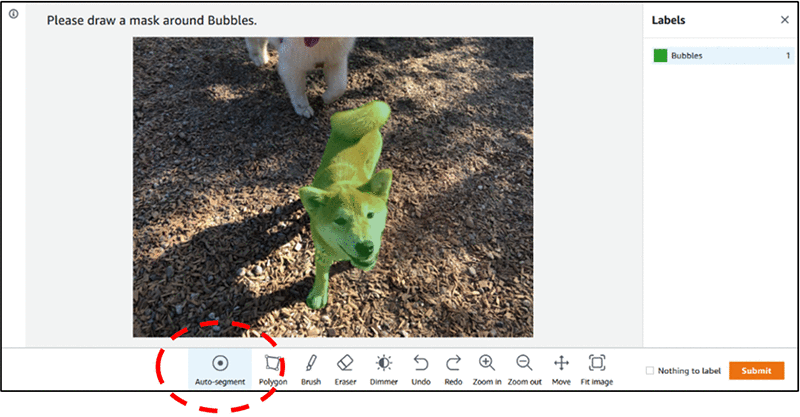
To increase labeling throughput, improve accuracy, and mitigate labeler fatigue, Ground Truth added the auto-segment feature to the semantic segmentation labeling user interface. The auto-segment tool simplifies the task by automatically labeling areas of interest in an image with only minimal input. 

Users can accept, undo, or correct the resulting output from auto-segment. The screenshot highlights the auto-segmenting feature in the toolbar, and shows that it captured the dog in the image as an object. 

With this new feature, users can work up to ten times faster on semantic segmentation tasks. Instead of drawing a tightly fitting polygon or using the brush tool to capture an object in an image, users draw four points: one at the top-most, bottom-most, left-most, and right-most points of the object. Ground Truth takes these four points as input and uses the Deep Extreme Cut (DEXTR) algorithm to produce a tightly fitting mask around the object. 

Monday, December 9, 2019

Microsoft Research Open Data Project lays down evolving standards for data access and reproducible research

Microsoft Research has announced that it will be adopting the Open Use of Data Agreement (O-UDA) data for several datasets that the company offers. 

The Open Use of Data Agreement (O-UDA) is intended to make it easier for individuals and organizations that want to share data to do so, with minimal requirements for users and no restrictions on use. The O-UDA is complemented by the Computational Use of Data Agreement (C-UDA), an agreement intended for situations where a specific data use scenario is desirable or required.


It is not appropriate for datasets that include any data that might include materials subject to privacy laws (such as the GDPR or HIPAA) or other unlicensed third-party materials. 

The O-UDA meets the open definition: it does not impose any restriction with respect to the use or modification of data other than ensuring that attribution and limitation of liability information is passed downstream. In the research context, this implies that users of the data need to cite the corresponding publication with which the data is associated. This aids in findability and reusability of data, an important tenet in the FAIR guiding principles for scientific data management and stewardship.

Microsoft recognizes that in certain cases, datasets useful for AI and research analysis may not be able to be fully “open” under the O-UDA. For example, they may contain third-party copyrighted materials, such as text snippets or images, from publicly available sources. 

The law permits their use for research, so following the principle that research data should be “as open as possible, as closed as necessary,” Microsoft developed the Computational Use of Data Agreement (C-UDA) to make data available for research while respecting other interests. The software giant will prefer the O-UDA where possible, but perceives the C-UDA as a useful tool for ensuring that researchers continue to have access to important and relevant datasets.

Microsoft researcher John Krumm and collaborators collected GPS data from 21 people who carried a GPS receiver in the Seattle area. Users who provided their data agreed to it being shared as long as certain geographic regions were deleted. 

This work covers key research on privacy preservation of GPS data as evidenced in the corresponding paper, “Exploring End User Preferences for Location Obfuscation, Location-Based Services, and the Value of Location,” which was accepted at the Twelfth ACM International Conference on Ubiquitous Computing (UbiComp 2010). The paper has been cited 147 times, including for research that builds upon this work to further the field of preservation of geo-privacy for location-based services providers.


Another example dataset is that of labeled hand images and video clips collected by researchers Eyal Krupka, Kfir Karmon, and others. The research addresses an important computer vision and machine learning problem that deals with developing a hand-gesture-based interface language. 

The data was recorded using depth cameras and has labels that cover joints and fingertips. The two datasets included are FingersData, which contains 3,500 labeled depth frames of various hand poses, and GestureClips, which contains 140 gesture clips (100 of these contain labeled hand gestures and 40 contain non-gesture activity). 

The research associated with this dataset is available in the paper “Toward Realistic Hands Gesture Interface: Keeping it Simple for Developers and Machines,” which was published in Proceedings of the 2017 CHI Conference on Human Factors in Computing Systems.

Finally, the FigureQA dataset generated by researchers Samira Ebrahimi Kahou, Adam Atkinson, Adam Trischler, Yoshua Bengio and collaborators, introduces a visual reasoning task for research that is specific to graphical plots and figures. 

Microsoft Research Open Data project was conceived from the start to reflect Microsoft Research’s commitment to fostering open science and research and to achieve this without compromising the ethics of collecting and sharing data. The company aims to make it easier for researchers to maintain provenance of data while having the ability to reference and build upon it.

Masimo secures FDA clearance for neonatal RD SET Pulse Oximetry sensors with improved accuracy specifications

Masimo announced that RD SET sensors with Masimo Measure-through Motion and Low Perfusion SET pulse oximetry have received FDA clearance ...