Showing posts with label Ethernet. Show all posts

Saturday, December 7, 2019

IDC reveals that the global Ethernet switch and router sector made marginal gains in the third quarter this year

Research firm IDC released Friday data on the global Ethernet switch market (Layer 2/3) that recorded US$7.32 billion in revenue in the third quarter of 2019, an increase of 0.1 percent year over year. Meanwhile, worldwide total enterprise and service provider (SP) router market revenues grew 0.8 percent year over year in the third quarter this year to $3.74 billion. These results were published Friday in the International Data Corporation (IDC) Worldwide Quarterly Ethernet Switch Tracker and Worldwide Quarterly Router Tracker

The Worldwide Quarterly Ethernet Switch Tracker and the Worldwide Quarterly Router Tracker provide total market size and vendor shares for the Ethernet switch and router technologies in an Excel pivot table format. The geographic coverage for both the Ethernet switch market and the router market includes eight major regions (USA, Canada, Latin America, Asia/Pacific (excluding Japan), Japan, Western Europe, Central and Eastern Europe, and Middle East and Africa) and 60 countries. 


The Ethernet switch market is further segmented by speed (100Mb, 1000Mb, 10Gb, 25Gb, 40Gb, 50Gb, 100Gb), product (fixed managed, fixed unmanaged, modular), and layer (L2, L3, ADC). Measurement for the Ethernet switch market is provided in vendor revenue, value, and port shipments. The router market is further split by product (high-end, mid-range, low-end, SOHO), deployment (service provider, enterprise), connectivity (core, edge), and the measurements are in vendor revenue, value, and unit shipments.

From a geographic perspective, the third quarter of this year Ethernet switch market delivered mixed results across the globe. The Middle East and Africa region grew 9.3 percent with the region's largest market, the United Arab Emirates, growing 6.9 percent year over year while Israel's market grew 18.8 percent. Across Europe, growth was stagnant. 

The Central and Eastern Europe (CEE) region lost 9.0 percent compared to a year earlier with Russia dropping 13.9 percent year over year. The Western Europe market fell 6.1 percent with Germany losing 5.6 percent year over year. Denmark was a bright spot in the region with 18.6 percent year-over-year growth. 

The Asia/Pacific (excluding Japan) (APeJ) region grew 1.3 percent year over year. In China, the market grew 4.6 percent year over year while the Philippines rose 25.9 percent. Japan was off 3.8 percent compared to its growth in the third quarter last year. In Latin America, the market dropped 4.4 percent year over year, while the U.S. market grew 2.6 percent annually and Canada declined 4.9 percent year over year. 


"The over-arching trend driving both the Ethernet switch and router markets continues to be enterprise, communications service provider, and cloud SP investments in agile cloud connectivity to meet the needs of their business and customers," said Rohit Mehra, vice president, Network Infrastructure at IDC. "The demand for higher speeds across a range of network connectivity options will spur growth in these markets in the coming years as bandwidth needs increase and mission-critical applications demand even lower latencies." 

Growth in the Ethernet switch market continues to be driven by the highest-speed switching platforms. For example, port shipments for 100Gb switches rose 57.2 percent year over year to 5.6 million. 100Gb revenues grew 32.8 percent year over year in the third quarter this year to $1.44 billion, making up 19.6 percent of total market revenue compared to 14.8 percent a year earlier. 

25Gb switches also saw growth with revenues increasing 69.3 percent to $463.4 million and port shipments growing 68.0 percent year over year. Lower-speed campus switches, a more mature part of the market, saw moderate growth in port shipments but declining revenue, pointing to a decrease in average selling prices (ASPs). 

10Gb port shipments rose 7.9 percent year over year, but revenue declined 8.7 percent to deliver 26.3 percent of total market revenue. 1Gb switches grew 3.9 percent year over year in port shipments but declined 7.4 percent in revenue. 1Gb now accounts for 39.2 percent of the total Ethernet switch market revenue. 

The worldwide enterprise and service provider router market increased 0.8 percent on a year-over-year basis in the third quarter this year with the major service provider segment, which accounts for 75.5 percent of revenues, decreasing 0.1 percent and the enterprise segment of the market growing 3.6 percent. 

From a regional perspective, the combined service provider and enterprise router market fell 1.5 percent in APeJ with the enterprise segment growing 1.5 percent and the service provider segment declining 2.2 percent year over year. Japan's total market grew 3.9 percent year over year. 

Revenues in Western Europe were off 7.3 percent year over year while CEE revenues for the combined enterprise and service provider market grew 3.5 percent year over year. The Middle East & Africa region was up 8.9 percent. In the U.S., the enterprise segment was up 7.3 percent while service provider revenues grew 1.8 percent, giving the combined markets 3.2 percent year-over-year growth. In Latin America, the market grew 11.7 percent. 

Cisco finished the thrid quarter this year with a 5.6 percent year-over-year decline in overall Ethernet switch revenues and market share of 51.3 percent. In the hotly contested 25Gb/100Gb segment, Cisco was the market leader with 38.2 percent revenue share. Cisco's combined service provider and enterprise router revenue declined 10.6 percent year over year with enterprise router revenue increasing 3.4 percent and SP revenues falling 18.1 percent. Cisco's combined SP and enterprise router market share increased to 37.9 percent, up from 36.8 percent in the second quarter of this year. 

Huawei's Ethernet switch revenue rose 4.4 percent on an annualized basis, giving the company market share of 8.9 percent. The company's combined SP and enterprise router revenue rose 20.6 percent year over year, giving the company a market share of 28.1 percent. 

Arista Networks saw Ethernet switch revenues increase 14.3 percent in the third quarter, bringing its share to 7.6 percent of the total market, up from 6.6 percent a year earlier. 100Gb revenues accounting for 68.8 percent of the company's total revenue, indicating the company's focus on hyperscale and cloud providers. 

HPE's Ethernet switch revenue declined 7.0 percent year over year, resulting in overall market share of 5.3 percent. 

Juniper's Ethernet switch revenue rose 4.5 percent year over year in the third quarter this year, bringing its market share to 3.2 percent. Juniper saw a 17.9 percent decline in combined enterprise and SP router sales, bringing its market share in the router market to 10.9 percent. 

"Dynamics in the Ethernet switch and routing markets continue to evolve," said Petr Jirovsky, research director, IDC Networking Trackers. "In Ethernet switching, the seemingly insatiable demand for higher-speed networking platforms continue to drive investments. Meanwhile, lower-speed campus switching continues to moderate as enterprises build out connectivity platforms to support mobile workers and the Internet of Things. In the routing segment, the enterprise continues to buoy the broader market as enterprises and service providers augment their networks to support improved cloud connectivity."

Saturday, November 16, 2019

Mellanox Skyway 200 Gigabit HDR InfiniBand to Ethernet gateway appliance released for high performance and cloud data centers

Mellanox Technologies introduced Mellanox Skyway, a 200 gigabit HDR InfiniBand to Ethernet gateway appliance. Mellanox Skyway enables a scalable and efficient way to connect the high-performance, low-latency InfiniBand data center to external Ethernet infrastructures or connectivity.


Mellanox Skyway is the next generation of the existing 56 gigabit FDR InfiniBand to 40 gigabit Ethernet gateway system, deployed in multiple data centers around the world.


High performance computing, artificial intelligence, data-intensive and cloud infrastructures leverage InfiniBand's high data throughput, extremely low latency, and smart in-network computing acceleration engines to deliver critical application performance and scalability. 


For cases requiring connectivity into external Ethernet-based platforms, Mellanox offers the Skyway appliance, a 1.6 terabit-per-second InfiniBand to Ethernet gateway appliance, supporting eight 100 or 200 gigabit ports on each of the InfiniBand and Ethernet sides. IT managers can scale the number of Skyway appliances over time to meet the demands of their users.


By leveraging the Mellanox Skyway appliance, InfiniBand data centers can maintain their lowest interconnect latency to ensure maximum applications performance. Other non-Ethernet or proprietary network providers offer network-integrated or silicon-integrated gateways to Ethernet, which impose higher interconnect latency within the data center that can reduce the overall data center performance.

Wednesday, November 13, 2019

NTT Electronics contributes Goldstone - open source network OS for disaggregated coherent transponders to telecom infra project

NTT Electronics delivered on Wednesday its Goldstone Network Operating Software (NOS *1) for disaggregated coherent transponders to the Telecom Infra Project’s NOS Software Project hosted by the Open Optical and Packet Transport project group. Launched in February 2016, TIP was started with the goal of accelerating the pace of innovation in the telecom industry.


Goldstone utilizes many existing open source components which have been developed in Open Compute Project (OCP *2) and Telecom Infra Project (TIP *3) including Open Network Linux (ONL *4), SONiC *5, Switch Abstraction Interface (SAI *6) and Transponder Abstraction Interface (TAI *7) to provide a full-fledged open source solution. ONL is used as the base operating system and provides a wide range of open network device support. 

NTT Electronics (NEL) has been developing and commercializing optical communications devices since 1995. It has complete portfolio of optical and electronics products to cover the industry needs for 100G-and-beyond link systems, ROADM components and FTTH networks.


On top of ONL, Kubernetes *8 is employed to enable containerized application management, which realizes flexible and modular software composition. SONiC/SAI is deployed as a fleet of containers when the target hardware comprises Ethernet switch ASIC, whereas TAI is used when the target hardware has coherent transponder components. 

Due to its modular architecture, Goldstone can be extended to support networking devices, which don’t have Ethernet ASIC, but may include conventional transponders, ROADMs or amplifiers in the future.
Goldstone was originally started as a prototype NOS for Edgecore’s Cassini Platform by the proposal from NTT Electronics. This has led to a production deployment by mixi in Japan. 


More than five industry partners are using Goldstone for evaluation on the Cassini platform. It is also being incorporated in Wistron’s Galileo platform.

The NOS is planned to be contributed to TIP Open Optical Packet Transport (OOPT *9) group as an open source project. Goldstone is planned to be part of a live running demonstration at the TIP Summit 2019.

Thursday, October 31, 2019

Cray debuts ClusterStor E1000 storage to power data-driven workloads including AI, analytics, simulation and modeling

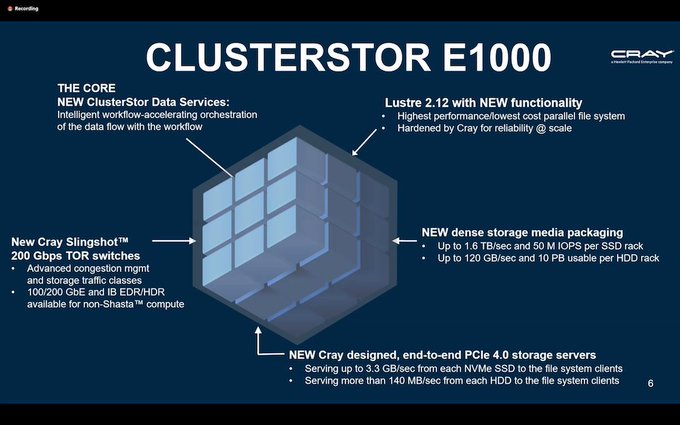
Cray, a Hewlett Packard Enterprise company unveiled on Wednesday its Cray ClusterStor E1000 system, a new parallel storage platform for the exascale era. ClusterStor E1000 addresses the explosive growth of data from converged workloads and the need to access that data at improved speed, by offering an optimal balance of storage performance, efficiency and scalability, effectively eliminating job pipeline congestion caused by I/O bottlenecks. 

Cray ClusterStor E1000 systems will be available starting in the first quarter of next year. 


The next-generation global file storage system has already been selected by the US Department of Energy (DOE) for use at the Argonne Leadership Computing Facility, Oak Ridge National Laboratory and Lawrence Livermore National Laboratory, where the first three US exascale supercomputers will be housed (respectively Aurora, Frontier and El Capitan).


With the introduction of the ClusterStor E1000 storage system, Cray has completed the re-architecture of its end-to-end infrastructure portfolio, which encompasses Cray Shasta supercomputers, Cray Slingshot interconnect, and the Cray software platform. With Cray’s next-generation end-to-end supercomputing architecture, available for any datacenter environment, customers around the world can unleash the full potential of their data.


Recognizing data access challenges presented by the exascale era, Cray’s ClusterStor E1000 enables organizations to achieve their research missions and business objectives faster. ClusterStor E1000 systems can deliver up to 1.6 terabytes per second and up to 50 million I/O operations per second per rack – more than double compared to other parallel storage systems in the market today.

The new system also deliver purpose-engineered end-to-end PCIe 4.0 storage controllers serve the maximum performance of the underlying storage media to the compute nodes and new intelligent Cray software, ClusterStor Data Services, allows customers to align the data flow with their specific workflow, meaning they can place the application data at the right time on the right storage media (SSD pool or HDD pool) in the file system.
An entry-level system starts at 30 gigabytes per second and at less than 60 terabytes usable capacity. Customers can start at the size dictated by their current needs and scale as those needs grow, with maximum architectural headroom for future growth. 


The ClusterStor E1000 storage system can connect to any HPC compute system that supports high speed networks like 200 Gbps Cray Slingshot, Infiniband EDR/HDR and 100/200 Gbps Ethernet.

Friday, October 25, 2019

Renesas expands access of IP solutions including 7nm process TCAM, advanced standard Ethernet TSN IPs

Renesas Electronics announced expanded access to its highly sought portfolio of intellectual property (IP) licenses that allow designers to meet a broad range of customer requirements in a rapidly changing industry. Starting today, customers will have access to IPs such as advanced 7nm (nanometer) SRAM and TCAM, and standard Ethernet time-sensitive networking (TSN) IP. 

Furthermore, Renesas is working on providing a system IP which includes PIM (processing in memory), which attracted attention as an AI accelerator, presented in a conference paper in June 2019. With these IPs, customers can jump start their advanced semiconductor device development projects, such as the development of next-generation artificial intelligence (AI) chips or ASICs for 5G networks.


The Renesas accelerator is based on the processing-in-memory (PIM) architecture, an increasingly popular approach for AI technology, in which multiply-and-accumulate operations are performed in the memory circuit as data is read out from that memory.

Customers developing custom chips or using FPGA devices for early development can leverage Renesas IP in their subsystem design or speed up software development, respectively, allowing them to focus resources on their speciality areas, speed up the development process, and bring highly competitive products to market. 


Customers who prefer to use existing software assets can take advantage of Renesas IP assets to achieve more efficient system development by reducing the resources required to develop, verify, and evaluate software and boards.

To support customers’ semiconductor development efforts, Renesas has also established a network of partner companies ready to support users' unique needs. This network includes design houses that perform contract semiconductor design and technology partners who will provide an array of software and middleware tools. 


This network will accelerate users' technology innovations and product development efforts by lowering the barriers to entry for semiconductor device and FPGA development. Renesas can also introduce experienced users to model-based design development environments that fully utilize leading-edge IP.

In September 2018, Renesas opened its extensive IP license portfolio, offering access to more than 40 licenses, including CPU cores, timer IP for motor applications, USB cores, and SRAM. In 2019, Renesas received over 100 enquiries and have started supplying IPs to many users. Renesas aims to exceed IP sales annual market growth rate of 10 percent, and will expand the provision of IP and support system while creating new, and expanding old, IP markets.

Thursday, October 24, 2019

Western Digital updates its data storage offerings for NAS environments

Western Digital introduced Thursday an array of purpose-built storage solutions for small businesses and home offices leveraging NAS environments. The solutions include the initial WD Red SSDs, which enhance performance and caching abilities in a hybrid NAS environment, as well as a 14TB capacity for the WD Red and WD Red Pro HDDs.

With the increase in virtualization, 10GbE (10 Gigabit Ethernet) and higher connectivity speeds are becoming an essential feature set in modern NAS systems. To help minimize a performance bottleneck, SSD speeds are crucial.


To fully support the requirements of these environments, storage device durability, speed and capacity remain heavily in demand. Building on the proven reliability of Western Digital’s WD Red product portfolio, the solutions are built to transform pain points to profits for the end user. When utilized as a caching solution in a NAS system, the WD Red SA500 SSD helps to boost performance while the new higher capacity WD Red and WD Red Pro HDDs offer more storage space in the same NAS device.

Masimo secures FDA clearance for neonatal RD SET Pulse Oximetry sensors with improved accuracy specifications

Masimo announced that RD SET sensors with Masimo Measure-through Motion and Low Perfusion SET pulse oximetry have received FDA clearance ...