Showing posts with label workflow. Show all posts

Tuesday, December 17, 2019

Infortrend incorporates DaVinci Resolve project server into its scale-out shared storage offering

Infortrend Technology releases on Tuesday its highly scalable shared storage EonStor CS that supports NLE software, such as DaVinci Resolve, Adobe Premiere Pro, and Final Cut Pro to facilitate collaborative editing of 4K and above ultra-high resolution videos. EonStor CS supports over 100 GB/s performance and 100 PB capacity, making it an ideal storage solution for large-scale post-production studios with more than ten workstations. 

In a traditional architecture, the database project server, which contains reels, edited files and timeline, is deployed on a dedicated workstation and connects to other workstations in a peer-to-peer network for editors, colorists, and animators to work together on the same project. Any single point of failure, however, will pose a threat to the project. 

In light of this issue, Infortrend integrates DaVinci Resolve Project Server into the shared media storage and provides RAID protection to guarantee high data availability. The simplified network architecture also makes deployment and management easier for video professionals to focus more on content production.


EonStor CS is a scale-out shared storage solution that allows enterprises to address the sheer volume of data via its scalable capacity and linear-increasing performance. The scalability through a scale-out expansion offers an easier and more cost-effective way of managing growing data in the agile enterprises while reducing consequent performance bottlenecks. 

EonStor CS also improves data utilization and simplifies data management by integrating data from all nodes into one cluster system. The superior performance and scalability make CS suitable for a wide range of data-intensive industries and applications such as media and entertainment (M&E), high-performance computing (HPC), video surveillance, file sharing and backup. 

With EonStor CS, enterprises gain speedy process for storage expansion and data migration. EonStor CS can keep up as the business grows, making it the optimized data storage and management solution.

Moreover, the shared media storage comes with user-friendly management software that is also designed to simplify the deployment. The EonOne software offers two accounts to separate different management roles. One account is for M&E User Administrator, who uses EonOne to set up user accounts and storage quota. The other account is for System Administrator, who is in charge of advanced configurations and maintenance.

In addition, Infortrend develops a client-based utility EonView, which is installed on Windows and macOS workstations to automatically detect the connected storage system and mount the assigned file folder according to the user credentials. This smart utility simplifies the complexities of storage system deployment and network setup, especially for video professionals who are not familiar with IT setting.  

“Infortrend offers comprehensive storage solutions for today’s M&E, no matter the business scale,” said Thomas Kao, senior director of Product Planning. “Besides its highly scalable performance and capacity for large workgroups to fulfill simultaneous workflows, CS supports high density 4U 60-bay form factor to deliver optimized size for massive data storage requirements. With the launch of CS, we aim to serve M&E customers with smarter, easier, and more flexible solutions,” 

Thursday, December 12, 2019

Amazon SageMaker Ground Truth enables auto-segmenting of objects when performing semantic segmentation labeling

Amazon Web Services announced Wednesday that its Amazon SageMaker Ground Truth helps build highly accurate training datasets for machine learning (ML) quickly. Ground Truth offers easy access to third-party and own human labelers, and provides them with built-in workflows and interfaces for common labeling tasks. 

Additionally, Ground Truth can lower labeling costs by up to 70 percent using automatic labeling, which works by training Ground Truth from data humans have labeled so that the service learns to label data independently. 

Amazon SageMaker Ground Truth helps users build highly accurate training datasets for machine learning quickly. SageMaker Ground Truth offers easy access to public and private human labelers and provides them with built-in workflows and interfaces for common labeling tasks. Additionally, SageMaker Ground Truth can lower labeling costs by up to 70 percent using automatic labeling, which works by training Ground Truth from data labeled by humans so that the service learns to label data independently.


Successful machine learning models are built on the shoulders of large volumes of high-quality training data. But, the process to create the training data necessary to build these models is often expensive, complicated, and time-consuming. The majority of models created today require a human to manually label data in a way that allows the model to learn how to make correct decisions. 

For example, building a computer vision system that is reliable enough to identify objects - such as traffic lights, stop signs, and pedestrians - requires thousands of hours of video recordings that consist of hundreds of millions of video frames. Each one of these frames needs all of the important elements like the road, other cars, and signage to be labeled by a human before any work can begin on the model that the user wants to develop.

Amazon SageMaker Ground Truth reduces the time and effort required to create datasets for training to reduce costs. These savings are achieved by using machine learning to automatically label data. The model is able to get progressively better over time by continuously learning from labels created by human labelers.

Where the labeling model has high confidence in its results based on what it has learned so far, it will automatically apply labels to the raw data. Where the labeling model has lower confidence in its results, it will pass the data to humans to do the labeling. 

The human-generated labels are provided back to the labeling model for it to learn from and improve. Over time, SageMaker Ground Truth can label more and more data automatically and substantially speed up the creation of training datasets. 


Semantic segmentation is a computer vision ML technique that involves assigning class labels to individual pixels in an image. For example, in video frames captured by a moving vehicle, class labels can include vehicles, pedestrians, roads, traffic signals, buildings, or backgrounds. It provides a high-precision understanding of the locations of different objects in the image and is often used to build perception systems for autonomous vehicles or robotics. 

To build an ML model for semantic segmentation, it is first necessary to label a large volume of data at the pixel level. This labeling process is complex. It requires skilled labelers and significant time—some images can take up to two hours to label accurately.

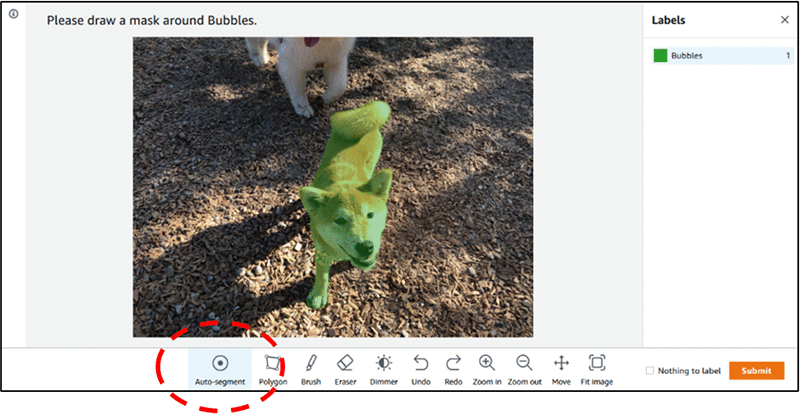
To increase labeling throughput, improve accuracy, and mitigate labeler fatigue, Ground Truth added the auto-segment feature to the semantic segmentation labeling user interface. The auto-segment tool simplifies the task by automatically labeling areas of interest in an image with only minimal input. 

Users can accept, undo, or correct the resulting output from auto-segment. The screenshot highlights the auto-segmenting feature in the toolbar, and shows that it captured the dog in the image as an object. 

With this new feature, users can work up to ten times faster on semantic segmentation tasks. Instead of drawing a tightly fitting polygon or using the brush tool to capture an object in an image, users draw four points: one at the top-most, bottom-most, left-most, and right-most points of the object. Ground Truth takes these four points as input and uses the Deep Extreme Cut (DEXTR) algorithm to produce a tightly fitting mask around the object. 

Thursday, November 28, 2019

International Medical Solutions launches CloudSync for Google Cloud healthcare customers transitioning to the cloud

International Medical Solutions (IMS), a Google Cloud Partner, announced a solution that will enable radiologists and other healthcare clinicians to transition to the cloud. 

The IMS CloudSync enables radiology sites to transition to the cloud and continue to use their legacy on-premise workstations and DICOM viewers. The front-end solution designed with the needs of initial Google Cloud Platform (GCP) users in mind uses an implementation that enables GCP to be added to an on-premise legacy viewing workflow, where GCP would act as the archive. 


The plug-and-play solution works out-of-the-box and allows PACS sites to sync their on-premise storage of medical images with their cloud storage. The added benefit is the sites can continue to use their legacy PACS workstations to view images stored in the cloud. 

"IMS has been working closely with Google Cloud to solve unmet needs for customers who are starting to transition to the cloud. CloudSync™ is an out-of-the-box, cost-effective solution that improves clinician workflows while enabling them to use on-prem legacy systems at the same time," says Vittorio Accomazzi, CTO of International Medical Solutions. Accomazzi adds, "Also, CloudSync inherently provides image sharing as it allows multiple sites to share and exchange images on GCP."

IMS CloudVue will also be featured at RSNA this year. The solution, which launched earlier this year, is a cloud-based viewing platform that provides the experience of an installed application on any device or workstation. CloudSync and CloudVue can also be used as a disaster recovery solution since CloudSync will upload the on-premise data onto GCP, which can be accessed using CloudVue. At any given time, the user has two copies of the data and at least two ways for accessing it.


Over the last year, IMS has worked closely with Google Cloud to enhance the integration with the Google Cloud Healthcare API, including integrating with machine learning backend.

Masimo secures FDA clearance for neonatal RD SET Pulse Oximetry sensors with improved accuracy specifications

Masimo announced that RD SET sensors with Masimo Measure-through Motion and Low Perfusion SET pulse oximetry have received FDA clearance ...