Showing posts with label Amazon SageMaker. Show all posts

Thursday, December 12, 2019

Amazon SageMaker Ground Truth enables auto-segmenting of objects when performing semantic segmentation labeling

Amazon Web Services announced Wednesday that its Amazon SageMaker Ground Truth helps build highly accurate training datasets for machine learning (ML) quickly. Ground Truth offers easy access to third-party and own human labelers, and provides them with built-in workflows and interfaces for common labeling tasks. 

Additionally, Ground Truth can lower labeling costs by up to 70 percent using automatic labeling, which works by training Ground Truth from data humans have labeled so that the service learns to label data independently. 

Amazon SageMaker Ground Truth helps users build highly accurate training datasets for machine learning quickly. SageMaker Ground Truth offers easy access to public and private human labelers and provides them with built-in workflows and interfaces for common labeling tasks. Additionally, SageMaker Ground Truth can lower labeling costs by up to 70 percent using automatic labeling, which works by training Ground Truth from data labeled by humans so that the service learns to label data independently.


Successful machine learning models are built on the shoulders of large volumes of high-quality training data. But, the process to create the training data necessary to build these models is often expensive, complicated, and time-consuming. The majority of models created today require a human to manually label data in a way that allows the model to learn how to make correct decisions. 

For example, building a computer vision system that is reliable enough to identify objects - such as traffic lights, stop signs, and pedestrians - requires thousands of hours of video recordings that consist of hundreds of millions of video frames. Each one of these frames needs all of the important elements like the road, other cars, and signage to be labeled by a human before any work can begin on the model that the user wants to develop.

Amazon SageMaker Ground Truth reduces the time and effort required to create datasets for training to reduce costs. These savings are achieved by using machine learning to automatically label data. The model is able to get progressively better over time by continuously learning from labels created by human labelers.

Where the labeling model has high confidence in its results based on what it has learned so far, it will automatically apply labels to the raw data. Where the labeling model has lower confidence in its results, it will pass the data to humans to do the labeling. 

The human-generated labels are provided back to the labeling model for it to learn from and improve. Over time, SageMaker Ground Truth can label more and more data automatically and substantially speed up the creation of training datasets. 


Semantic segmentation is a computer vision ML technique that involves assigning class labels to individual pixels in an image. For example, in video frames captured by a moving vehicle, class labels can include vehicles, pedestrians, roads, traffic signals, buildings, or backgrounds. It provides a high-precision understanding of the locations of different objects in the image and is often used to build perception systems for autonomous vehicles or robotics. 

To build an ML model for semantic segmentation, it is first necessary to label a large volume of data at the pixel level. This labeling process is complex. It requires skilled labelers and significant time—some images can take up to two hours to label accurately.

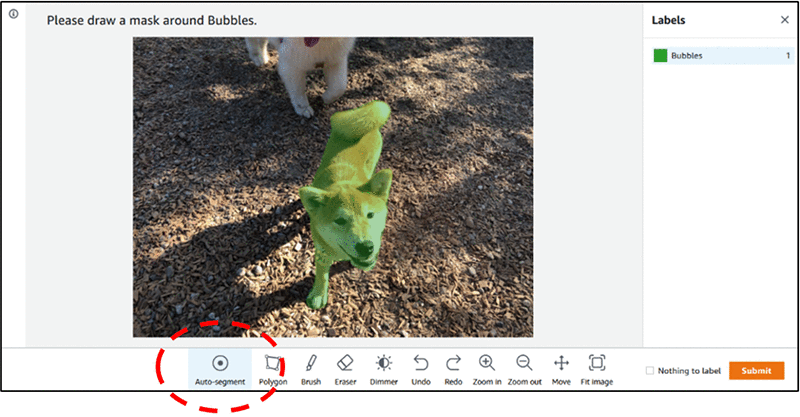
To increase labeling throughput, improve accuracy, and mitigate labeler fatigue, Ground Truth added the auto-segment feature to the semantic segmentation labeling user interface. The auto-segment tool simplifies the task by automatically labeling areas of interest in an image with only minimal input. 

Users can accept, undo, or correct the resulting output from auto-segment. The screenshot highlights the auto-segmenting feature in the toolbar, and shows that it captured the dog in the image as an object. 

With this new feature, users can work up to ten times faster on semantic segmentation tasks. Instead of drawing a tightly fitting polygon or using the brush tool to capture an object in an image, users draw four points: one at the top-most, bottom-most, left-most, and right-most points of the object. Ground Truth takes these four points as input and uses the Deep Extreme Cut (DEXTR) algorithm to produce a tightly fitting mask around the object. 

Monday, December 2, 2019

Amazon SageMaker Operators for Kubernetes capability helps developers, data scientists to train, tune, deploy ML models

AWS released on Monday Amazon SageMaker Operators for Kubernetes capability that makes it easier for developers and data scientists using Kubernetes to train, tune, and deploy machine learning (ML) models in Amazon SageMaker. Customers can install these Amazon SageMaker Operators on their Kubernetes cluster to create Amazon SageMaker jobs natively using the Kubernetes API and command-line Kubernetes tools such as ‘kubectl’.

Many AWS customers use Kubernetes, an open-source general-purpose container orchestration system, to deploy and manage containerized applications, often via a managed service such as Amazon Elastic Kubernetes Service (EKS). This enables data scientists and developers, for example, to set up repeatable ML pipelines and maintain greater control over their training and inference workloads. 


Amazon SageMaker brings down deep learning inference costs by up to 75 percent using Amazon Elastic Inference to attach elastic GPU acceleration to Amazon SageMaker instances. For most models, a full GPU instance is over-sized for inference. Also, it can be difficult to optimize the GPU, CPU, and memory needs of your deep learning application with a single instance type. 

Elastic Inference allows users to choose the instance type that is best suited to the overall CPU and memory needs of your application, and then separately configure the right amount of GPU acceleration required for inference.


However, to support ML workloads these customers still need to write custom code to optimize the underlying ML infrastructure, ensure high availability and reliability, provide data science productivity tools, and comply with appropriate security and regulatory requirements. 

For example, when Kubernetes customers use GPUs for training and inference, they often need to change how Kubernetes schedules and scales GPU workloads in order to increase utilization, throughput, and availability. Similarly, for deploying trained models to production for inference, Kubernetes customers have to spend additional time in setting up and optimizing their auto-scaling clusters across multiple Availability Zones.


Amazon SageMaker Operators for Kubernetes bridges this gap, and customers are now spared all the heavy lifting of integrating their Amazon SageMaker and Kubernetes workflows. Starting Monday, customers using Kubernetes can make a simple call to Amazon SageMaker, a modular and fully-managed service that makes it easier to build, train, and deploy machine learning (ML) models at scale. 

With workflows in Amazon SageMaker, compute resources are pre-configured and optimized, only provisioned when requested, scaled as needed, and shut down automatically when jobs complete, offering near full utilization. 

Now with Amazon SageMaker Operators for Kubernetes, customers can continue to enjoy the portability and standardization benefits of Kubernetes and EKS, along with integrating the many additional benefits that come out-of-the-box with Amazon SageMaker, no custom code required.


Each Amazon SageMaker Operator for Kubernetes provides users with a native Kubernetes experience for creating and interacting with jobs, either with the Kubernetes API or with Kubernetes command-line utilities such as kubectl. Engineering teams can build automation, tooling, and custom interfaces for data scientists in Kubernetes by using these operators—all without building, maintaining, or optimizing ML infrastructure. 

Data scientists and developers familiar with Kubernetes can compose and interact with Amazon SageMaker training, tuning, and inference jobs natively, as users would with Kubernetes jobs executing locally. Logs from Amazon SageMaker jobs stream back to Kubernetes, allowing consumers to natively view logs for model training, tuning, and prediction jobs in command line.

Wednesday, November 20, 2019

AWS uses Step Functions to orchestrate Amazon EMR workloads

Amazon Web Services announced its AWS Step Functions that allows users to add serverless workflow automation to their applications. The steps of the workflow can run anywhere, including in AWS Lambda functions, on Amazon Elastic Compute Cloud (EC2), or on-premises. 


Workflows are made up of a series of steps, with the output of one step acting as input into the next. Application development is simpler and more intuitive using Step Functions, because it translates workflow into a state machine diagram that is easy to understand, easy to explain to others, and easy to change. 

Users can monitor each step of execution as it happens, which means they can identify and fix problems quickly. Step Functions automatically triggers and tracks each step, and retries when there are errors, so that the application executes in order and as expected.

Step Functions connects to Amazon EMR to create data processing and analysis workflows with minimal code, saving time, and optimizing cluster utilization. For example, building data processing pipelines for machine learning is time consuming and hard. With this new integration, users have a simple way to orchestrate workflow capabilities, including parallel executions and dependencies from the result of a previous step, and handle failures and exceptions when running data processing jobs.

Specifically, a Step Functions state machine can create or terminate an EMR cluster, including the possibility to change the cluster termination protection. In this way, consumers can reuse an existing EMR cluster for their workflow, or create one on-demand during execution of a workflow. It also can add or cancel an EMR step for their cluster. 


Each EMR step is a unit of work that contains instructions to manipulate data for processing by software installed on the cluster, including tools such as Apache Spark, Hive, or Presto.

The offering can also modify the size of an EMR cluster instance fleet or group, allowing users to manage scaling programmatically depending on the requirements of each step of the workflow. For example, the user may increase the size of an instance group before adding a compute-intensive step, and reduce the size after it has completed.

When creating or terminating a cluster or add an EMR step to a cluster, users can use synchronous integrations to move to the next step of the workflow only when the corresponding activity has completed on the EMR cluster.

Masimo secures FDA clearance for neonatal RD SET Pulse Oximetry sensors with improved accuracy specifications

Masimo announced that RD SET sensors with Masimo Measure-through Motion and Low Perfusion SET pulse oximetry have received FDA clearance ...